|
|
The July Project: Day 20
I received a note this morning from a Facebook friend who’s struggled as hard with weight loss for most of her adult life as I have. She asked, “Can you send me some of you exercise motivation magic? [I’ve] fallen off the wagon…. The battle never seems to end.”
I wrote back to say that I know the feeling very well, but that somehow it’s helped to stop thinking about fitness in those terms. I’ve tried to make exercise part of who I am—not a short-term project, and not a battle, either. Her words stayed with me all day: the battle never seems to end.
Last weekend I happened to catch an interview with Valerie Bertinelli on CBS News Sunday Morning in which the 49-year-old actress talked about losing 45 pounds, and about her efforts to come to terms with why she gained the weight in the first place. She mentioned plans to run a marathon, and the interviewer chose to sum up the story …[MORE]
The July Project: Day 18
In 2008, I attended a lecture by Dr. Henry Lodge, one of the authors of Younger Next Year , a book that purports to offer ideas to help men fend off some of the physical symptoms of aging. The central theme of Dr. Lodge’s talk was a point that might seem counterintuitive: that we need more exercise as we get older, not less.
In the question-and-answer session that followed his presentation, someone asked Dr. Lodge, “So how much exercise is the right amount?” He replied that although no one has nailed down a precise, scientific answer to that question, a good rule of thumb might be four days a week in your 40s, five days a week in your 50s, and six days a week from your 60s on …[MORE]
The July Project: Day 15
For the queen bee, and also everyone else
You have a lot of priorities to juggle. You do what you can, you assign degrees of urgency based on trying to find some kind of balance between what you want and need and what the people who depend on you—your family, your friends, your co-workers, your boss, your clients—want and need. And with a little luck, you get all of the most critically important things taken care of on any given day. Or maybe you don’t, but at least you get to them the same week. Or maybe you don’t, but you do what you can do, and it has to be enough…right?
And while you’re working on all of that, be sure to take care of yourself. Like the man said, “Beyond a wholesome discipline, be gentle with yourself.” Get some rest, drink plenty of fluids. Stay out of the hot sun. Let someone take care of you for a while.
The July Project: Day 2
I see T‑shirts with slogans like “Softball is life,” “Rugby is life,” “Shark-diving is life,” and so on. I used to find them stupid and arrogant. What the heck is that even supposed to mean: softball is life? Obviously, there’s a lot more to life than softball.
Gotta have it? Go ahead and click. I won’t tell.
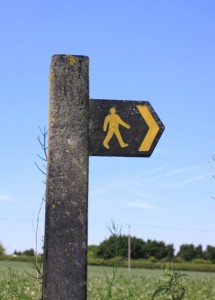
Then I found my own exercise passion: walking. It didn’t turn into an obsession overnight, and I never felt compelled to rush out and buy a walking is life T‑shirt. But I got hooked on it.
And over the course of several years, I discovered the wisdom of the T‑shirts …[MORE]
Last weekend I told some friends about the work of Aubrey de Grey, gerontologist and chief science officer of the Strategies for Engineered Negligible Senescence (SENS) Foundation. Dr. de Grey speculates that we’re eventually going to cure the causes of aging and that some day humans will live to be a thousand years old. That notion always gets me thinking about a question I find intriguing: How would you live your life differently if you knew you had another thousand years to live?
Let me put it another way: How would you treat your body if you knew it had to last another thousand years? Would you quit smoking? Would you be more careful about what you eat? …[MORE]
|
| “ |
The master in the art of living makes little distinction between his work and his play, his labor and his leisure, his mind and his body, his information and his recreation, his love and his religion. He hardly knows which is which. He simply pursues his vision of excellence at whatever he does, leaving others to decide whether he is working or playing. To him he’s always doing both.” |
—James Michener
|